

Table of Contents
Prologue
In many organizations transforming towards agile ways of working, the Scrum Master and the Project Manager role get merged. Although the two roles have a lot in common, they aren’t interchangeable. Combining them without clearly defining responsibilities can create real problems, such as unnecessary status meetings, confusion about when and to whom issues should be escalated, and uncertainty about which skills to develop for career growth.
Have you ever been in a meeting where someone asked who was actually responsible for solving the issue: the Scrum Master or the Project Manager, and nobody knew the answer?
In my personal experience of filling both roles, the friction in collaboration is mostly caused by a lack of clarity on who has what decision rights, not the titles per se. This article highlights seven differences, one real-world example, and a simple decision support mechanism to assess the actual needs of your team.
Updated October 2026: checked against the 2020 Scrum Guide and Scrum.org guidance

First, One Clarification That Removes Most of the Confusion
These two things are not the same kind of thing:
- 🧩 Scrum Master is one of three accountabilities defined by the Scrum Guide, alongside the Product Owner and the Developers. It exists within a framework.
- 🏷️ Project Manager is a job title. Organizations may define their own PM roles, and Scrum does not define a Project Manager accountability.
That’s not to say that project-management tasks cease to exist when a team adopts Scrum. According to Scrum.org, these duties don’t disappear, but rather get distributed to the Scrum Master, Product Owner, and Developer accountabilities (and the wider organization). Which bits go to which depends on the company.
The examples below reflect common practices, not hard-and-fast rules. Every organization may divide responsibilities differently based on its needs.
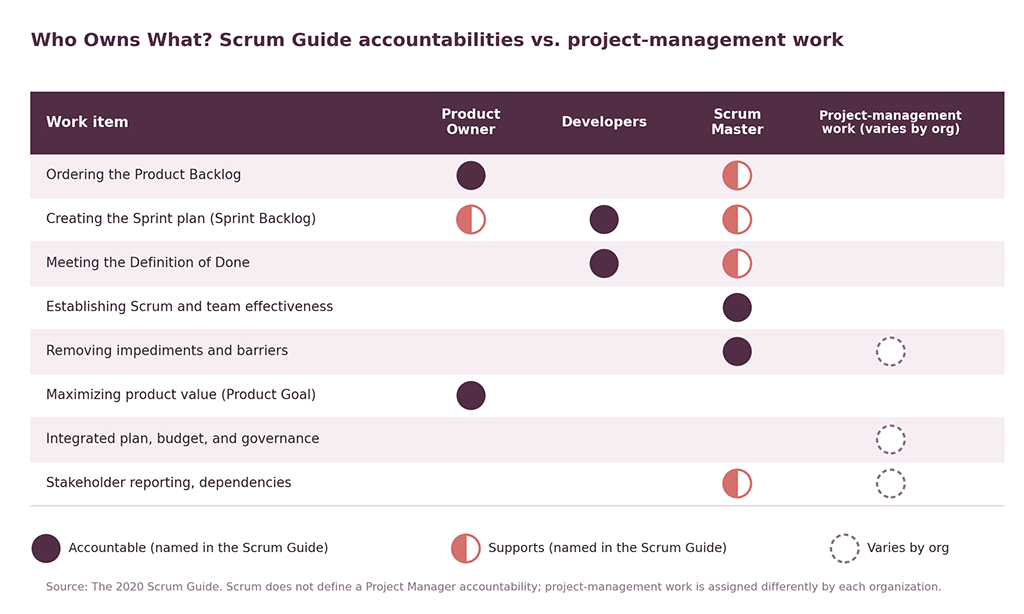
The support markers indicate related Scrum Guide responsibilities, not shared responsibility for the work item. The Product Owner remains accountable for ordering the Product Backlog, while the Developers create the Sprint plan.
1. 🎯 Primary Focus and Approach
Scrum Master: Responsible for establishing Scrum, as defined in the Scrum Guide, and for the Scrum Team’s effectiveness. They do that by coaching, facilitating, removing impediments, and helping the organization understand how to adopt and use Scrum.
Project Manager: Responsible for delivery, including timelines, scope, budget, risks, dependencies, and stakeholder coordination. Many PMs work in predictive or hybrid environments, but not all. Many PMs work in predictive or mixed environments, but not necessarily all of them.
A quick example. The launch date is at risk because an external API is delayed. The Project Manager would update the delivery forecast, assess the available options, and explain them to stakeholders. The Scrum Master supports the team in highlighting the impediment, inspecting the impact, and improving the collaboration practices around it. And in a small organization, one person may be doing both.
2. ⛓ Authority over the Team
There are a lot of misconceptions about this, so let’s take a closer look.
A Scrum team is self-managing, which means that within the team, there is no one who can dictate to the developers how to build the product. The Guide says that the Scrum team members determine for themselves who does what, when, and how. That is, a team member cannot give instructions to another team member. There can be no subteams within the team itself. A few things might surprise you about the responsibilities of team members:
- The developers are the only ones who decide how to deliver Product Backlog items as an Increment. No one will tell them how to do it.
- Only the Product Owner has the right to cancel the Sprint.
- The Scrum Master, in many ways, is a leader of the team and organization, serving in that capacity. That is, the Scrum Master influences others through coaching rather than direct authority.
A Project Manager, on the other hand, may have the authority to make decisions about the budget, governance, resources, or scope trade-offs, depending on what the organization delegates to them. How much authority the project manager has depends entirely on how his or her job description was created.
One of the differences explains the confusion between line-management authority and the authority over the delivery of the product. These two authorities are not the same.
3. 📐 Constraints and Scope
Scrum doesn’t mean working without deadlines, budgets, or commitments. Even with an adaptive approach, teams still need to plan, manage constraints, and work with stakeholders to make trade-offs.
- During the course of a Sprint, changes should not be made that endanger the Sprint Goal, and decreases in quality should not happen. It is necessary to clarify and renegotiate scope with the Product Owner as more is learned during the course of the delivery.
- The Product Owner orders the items in the Product Backlog. The Developers own the Sprint Backlog, which represents their plan for the Sprint.
- The Scrum Master is responsible for ensuring that Scrum events happen, are productive, and are timeboxed appropriately.
- Where a Project Manager is involved, he/she typically manage the triple constraint and the conversations with stakeholders about it.
When the deadline is fixed, the real discussion should be about what scope can be adjusted to meet it, rather than simply expecting the team to work faster. That conversation is between the product owner, the developers, and whoever is handling stakeholder expectations, and it should never promise certainty the team can deliver.
4. 🧱 Responsibilities
If the same blockers in the team that the Scrum Master is supposed to remove continue to happen sprint after sprint with nobody addressing them, that is a sign the Scrum Master role is not being fulfilled. If you have been caught off guard by a scope change with no accompanying change to the resource plan, or a deadline creeping up on you, that is a sign the project-management role is not being fulfilled. Not always: there are other causes.
Here is a practical view of who typically owns what: it is a guide, not a universal job description.
| Aspect | Scrum Master (accountability) | Project Manager (typical remit, varies) |
|---|---|---|
| Leadership | Servant-leader and coach | Leads delivery coordination; style varies by person and organization |
| The team | Coaches self-management and cross-functional teamwork | Coordinates plans and resources; authority over people varies |
| Stakeholders | Serves the Product Owner and facilitates stakeholder collaboration as needed | Status updates, expectations, and communication with sponsors and leadership |
| Risk | Impediments and how well the team’s process works | Project risks: dependencies, budget, resourcing, feasibility |
| Artifacts and documents | Does not own the Scrum artifacts; helps keep them transparent | Project plan, RAID log, status reports (formats vary) |
For reference, the Product Owner is accountable for effective Product Backlog management, including ordering the backlog. The Developers create the Sprint Backlog and are accountable for instilling quality by adhering to the Definition of Done.
When things go wrong, knowing when and how to escalate the issue is important. If a Sprint is struggling because of how the team works together, that is a Scrum Master conversation. If a project is drifting because of budget, dependencies, or governance, that is a project-management conversation. Often both conversations are needed, and the Product Owner decides the product-value questions that neither role can.

5. 📊 Metrics of Success
The initial statement, ‘PM = on time and on budget, Scrum Master = happy team,’ is not entirely accurate because there are several other dimensions to this particular practice. These dimensions include metrics that are used to evaluate success, and no individual has exclusive control over any of these:
| Dimension | Why it matters |
|---|---|
| Product value and business outcomes | The point of the work |
| Quality | Increments that actually meet the Definition of Done |
| Predictability | Forecasts that turn out to be reliable over time |
| Sustainable pace | The Guide notes sustainable Sprints improve focus and consistency |
| Impediment patterns and improvement | Are the same problems recurring, or getting solved? |
| Budget, schedule, scope baselines | Where a project-management role exists, these are tracked too |
A brief note on velocity – it is a planning aid for one specific team, derived from that team’s own estimating practices. The Scrum Guide doesn’t define it; it talks about forecasting practices such as burn-downs, burn-ups, and cumulative flow, all useful, but none of them substitute for inspecting what actually happened. Using velocity to compare teams or reward the team that delivers more is likely to lead to consistently higher estimates from those who benefit from delivering more points.
6. 🧠 How SM & PM Think and Make Decisions
The caricatures are easy (the PM predicts and controls, the Scrum Master adapts and empowers) and mostly wrong. Strong Project Managers know when to adapt, when to coach, and when to work with others to get things done.
The better contrast is the type of question each is likely to ask when things go off-track:
- Project Manager: What options and impacts do stakeholders need to decide between?
- Scrum Master: What is preventing the team from learning, adapting, and delivering value?
Both have value. Teams get into trouble when they don’t have someone asking one or the other.
7. 🌍 Collaboration, Especially in Hybrid Setups

There are a few practices that seem almost mandatory for distributed cooperation, but they are less critical for collocated teams:
- 📝 Working agreements: overlapping working hours, response intervals, and decision-making logics
- 🔎 Visible decisions: somewhere in the process, not just in the heads of the participants
- 💬 Asynchronous updates by default: Prefer asynchronous communication to save time for coordination that genuinely requires a meeting or live discussion.
- 🕐 Time-zone-aware planning: not requiring someone to be available at 24:00 their local time for a daily stand-up
- 🤝 Inclusive facilitation: a shared responsibility, not a superpower of the Scrum Master; they still have to optimize the process and remove obstacles, but not everyone has to be available for immediate feedback loops
- 📈 A clear escalation path: a strategy that actually exists and can be followed to report impediments
A note on metrics: if there is a Program Manager that needs to forecast on a program level, the most valuable input from each team is probably a confidence interval with explanations, not a single number that is internally negotiated between members.
One Delivery Problem, Two Different Lenses
Please note that this is a sample paper for your purposes. This is not an actual case study involving your real-life clients.
There is a very probable scenario in which a software team will miss a delivery due to a problem involving third-party integration, and QA has just discovered a significant bug. Various stakeholders need a reliable forecast, but the available evidence is inconclusive at best.
| Project-management lens | Scrum Master lens | |
|---|---|---|
| First action | Address the impact on milestones and dependencies | Make the impediment visible to the team |
| Working with others | Present realistic options, such as delivering less or later or rolling out a partial solution | Facilitate collaboration between Developers, the Product Owner, QA, and the external organization |
| Communication | Share the forecast, risk, and required decisions with stakeholders | Avoid mandating the specific decision; protect the team’s self-management |
| Afterwards | Coordinate the decision on release date and contingency plan | Help inspect why and choose one improvement |
The shared reality: neither role can make uncertainty disappear. The Product Owner remains accountable for product value and backlog ordering, and the Developers own their plan for the work. In a smaller organization, one person may wear both hats, but the accountabilities should still be explicit.
Which One Does Your Situation Actually Need?
| If this keeps happening | The likely gap | Note |
|---|---|---|
| The same blockers resurface every Sprint; events feel like rituals | Scrum Master accountability | Coaching, facilitation, impediment removal |
| Stakeholders are repeatedly surprised by dates, budget, or cross-team dependencies | Project-management work | Forecasting, reporting, dependency coordination |
| The team argues about what to build next, or priorities keep shifting | A Product Owner issue | Neither a Scrum Master nor a Project Manager can fix this |
| One person is expected to do both jobs | Possible, with explicit decision rights | Scrum.org warns that combining them can leave too little bandwidth for either |
What Matters More: Clear Responsibilities or Job Titles?
A Scrum Master and a Project Manager are not necessarily synonyms, but they also cannot be regarded as completely separate. A Scrum Master is someone who establishes and facilitates Scrum, and improves the performance of the team. A Project Manager’s span of control depends on the organization, but it generally covers the delivery of scope, time, risk, dependencies, governance, and stakeholders. In some organizations, those areas are not entirely separated.
Therefore, the real question is not which position is better. Instead, it is whether the team and the organization have appropriate accountabilities, decision-making, and support to achieve results.
Thus, for the hiring manager, it is important to describe the problem they want to be solved, not the solution of employing one person who will do everything. For individuals, it comes down to what they enjoy more: helping a team improve its performance or managing delivery while balancing project constraints.
Frequently Asked Questions (FAQ)
Is a Scrum Master the same thing as a Project Manager?
A Scrum Master is a particular type of the three Scrum accountabilities. A Scrum Master’s role is to establish Scrum and promote Scrum Team efficiency. A Project Manager is an organizational function; accordingly, it may vary from company to company.
Does Scrum have a Project Manager?
The Scrum Guide does not acknowledge the Project Manager accountability. The guide stipulates that there are three types of accountabilities in the Scrum team, including Scrum Master, Product Owner, and Developers. The company can choose to have a Project Manager who takes up all the delivery, governance, and stakeholder management functions.
Can I hold both the roles of Scrum Master and Project Manager?
Yes, the organization can hire you as both Project Manager and Scrum Master. In your capacity as a Scrum Master, you should focus on understanding the various roles and responsibilities of the two positions and ensure that your actions as a Scrum Master do not impede the team’s ability to self-manage. You should also make clear the areas of overlap between the two roles.
Does the Scrum Master assign work to Developers?
No, the Scrum Master does not assign work to Developers. It is the Developers’ responsibility to design and adjust the work plan for the Sprint. Therefore, during the Sprint, the Developers structure their work to achieve the Sprint Plan.
Who is responsible for keeping the project on schedule and managing its scope?
There’s no single answer. It depends on the organization’s policies and procedures. The Project Manager could be the person to turn to, as they represent the company’s interests depending on their policy. The Product Owner is responsible for prioritizing the Product Backlog, while Developers plan and adjust their work plan according to the Sprint. The company’s governance structure also helps determine who is responsible for managing the project’s scope, schedule, budget, stakeholders, and other constraints.
Does an Agile team require both a Scrum Master and a Project Manager?
An Agile team does not require both a Scrum Master and a Project Manager since the responsibilities could overlap. The company’s management should decide on the competencies required to undertake the project and allocate the roles and responsibilities accordingly. For example, the company considers several factors when deciding whether to have a Scrum Master or a Project Manager. These factors include but are not limited to adequate delivery of Scrum, general delivery, management of dependencies, and stakeholder management. The roles may overlap, but each person’s responsibilities should be clearly defined.
Official Scrum Resources
- The 2020 Scrum Guide, Ken Schwaber and Jeff Sutherland
- Scrum.org: The Difference between a Scrum Master and a Project Manager
- Scrum.org: Can a Project Manager be a Scrum Master?
Also Read
- 7 Sprint Planning Templates That Save Teams From Chaos: Practical templates for organizing and improving sprint planning.
- 9 Slides Every Weekly Status Report Needs to Impress Founders and Product Owners: A practical guide to reporting project progress, risks, and decisions.
- 5 Powerful RAG Status Formulas Every PM Should Use in Sprint Reports: Guidance on communicating delivery status using red, amber, and green indicators.
- 5 Reasons Your Project Charter Gets Ignored (And a Better Way to Build One): A resource for clarifying project objectives, scope, and stakeholder expectations.